36V vs 48V Lithium Golf Cart Batteries: 60Ah, 105Ah and 120Ah Compared
Choosing a lithium golf cart battery starts with system voltage, not capacity. A 38.4V nominal pack belongs on a compatible 36V-class system; a 51.2V nominal pack belongs on a compatible 48V-class system. Once voltage is correct, amp-hours and watt-hours help buyers compare how much nominal energy each model stores.
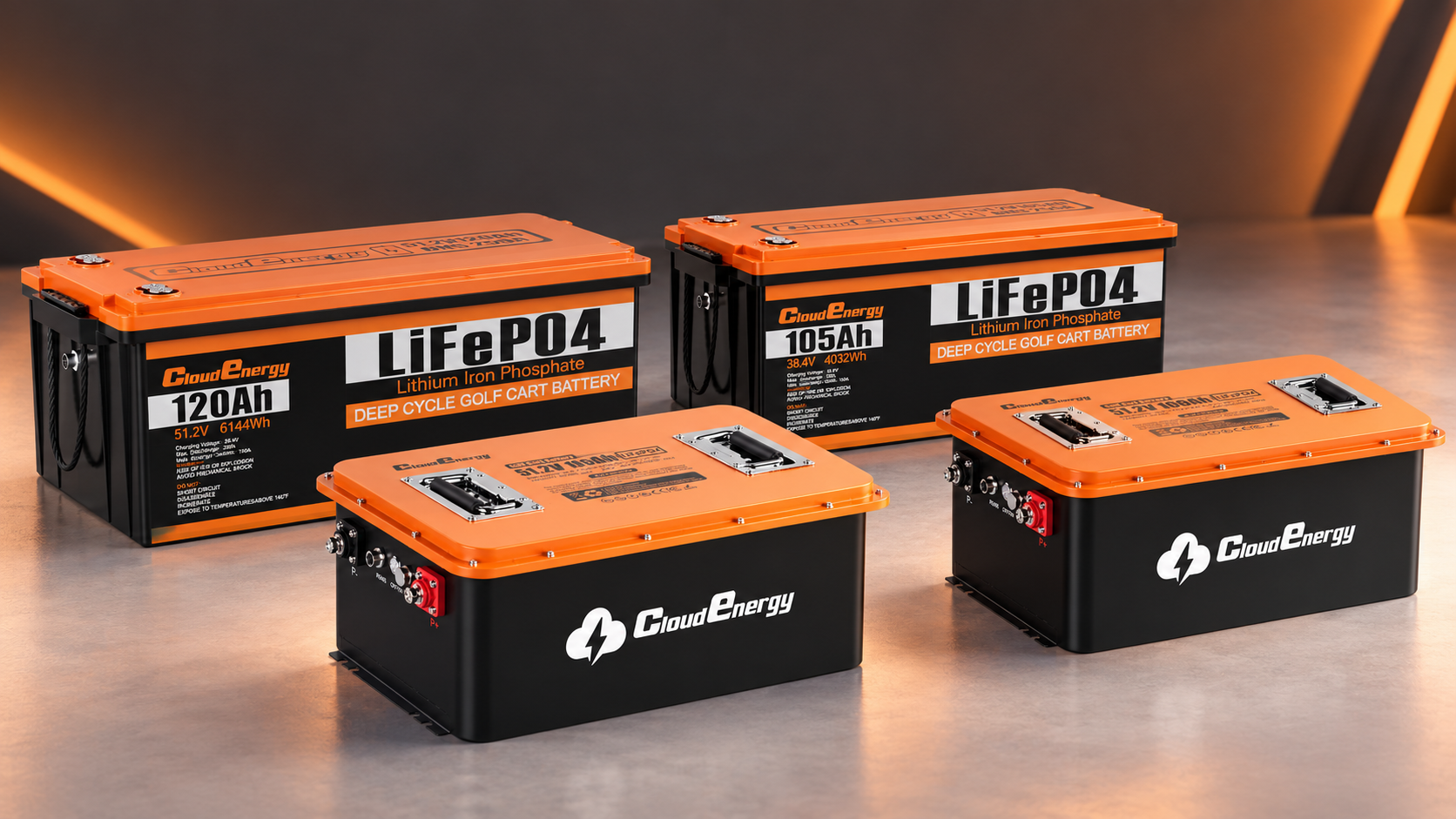
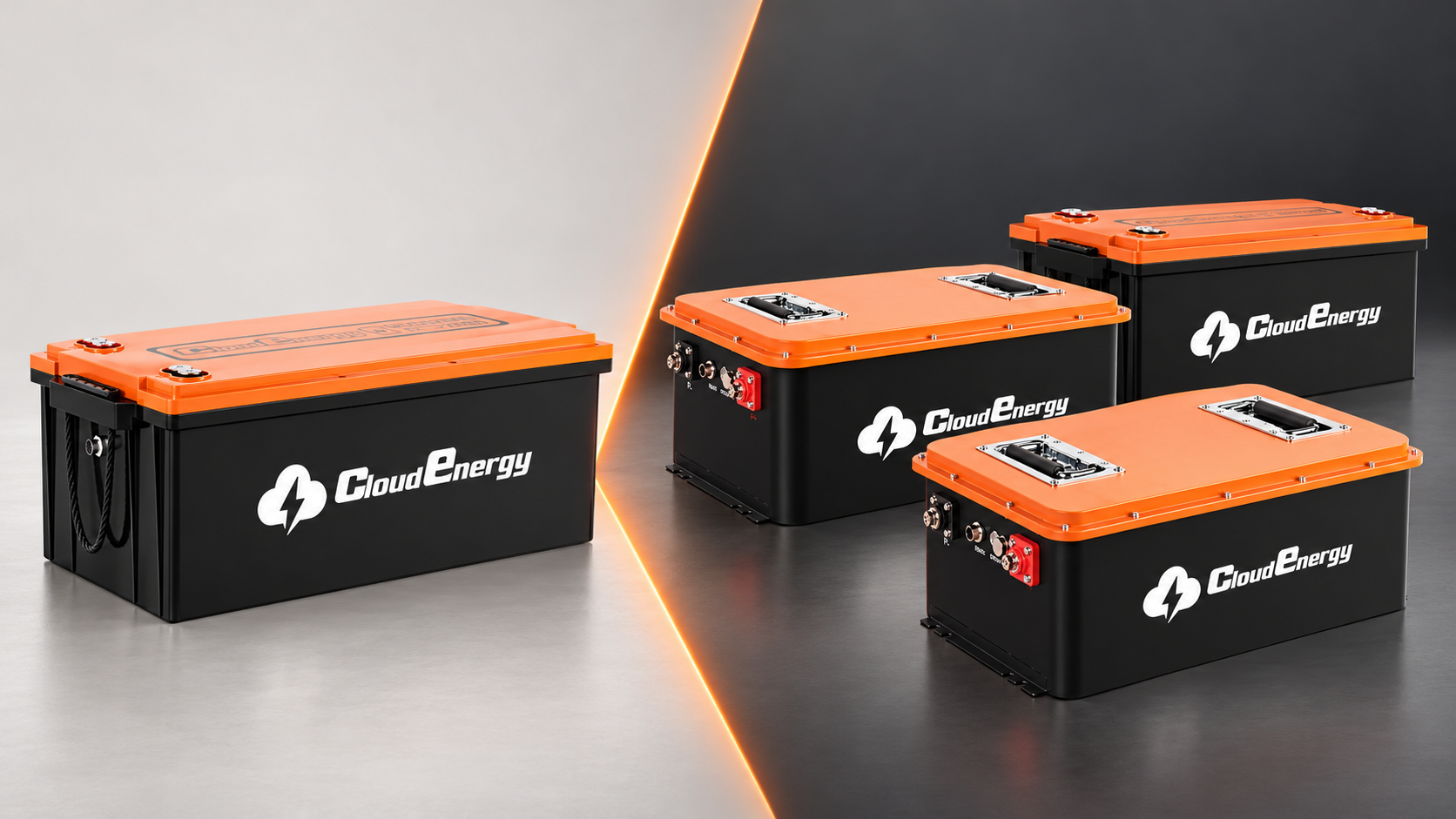
CloudEnergy’s UL 2271-certified lineup makes that comparison straightforward: one 36V 105Ah model and three 48V models at 60Ah, 105Ah and 120Ah.
Quick answer: Choose the correct voltage class first. Within the 48V group, 60Ah offers 3.07kWh, 105Ah offers 5.38kWh and 120Ah offers 6.14kWh. More energy can support a longer duty cycle, but actual range and suitability depend on the vehicle and operating conditions.
Side-by-side specification comparison
| Exact model | Voltage class | Nominal voltage | Capacity | Nominal energy | Standard discharge | Maximum discharge | Reported weight |
| GFA36V-105Ah With Charger | 36V | 38.4Vdc | 105Ah | 4,032Wh | 200A | 250A | approx. 30.7kg |
| GFS48V-60AH With Charger | 48V | 51.2Vdc | 60Ah | 3,072Wh | 100A | 250A | approx. 28.7kg |
| GFS48V-105AH With Charger | 48V | 51.2Vdc | 105Ah | 5,376Wh | 200A | 250A | approx. 43.0kg |
| GFA48V-120AH-R | 48V | 51.2Vdc | 120Ah | 6,144Wh | 100A | 250A | approx. 43.0kg |
All four models are certified to ANSI/CAN/UL/ULC 2271:2023. They also share a reported maximum charge current of 100A and maximum discharge current of 250A. However, their standard currents, charge voltages, energy and physical constructions differ. The table is a shortlist tool, not a universal compatibility chart.
36V or 48V: match the vehicle before comparing capacity
The GFA36V-105Ah With Charger is a 12S1P LiFePO4 pack with a nominal voltage of 38.4Vdc. Its standard charge voltage is 43.8V and its end-of-discharge voltage is 30V.
The three 48V-class batteries use 16S1P configurations and have a nominal voltage of 51.2Vdc. Their standard charge voltage is 58.4V and end-of-discharge voltage is 40V.
These products are not interchangeable simply because the connector can be made to fit. Using the wrong voltage class can create serious problems for the controller, motor, charger, DC-DC converter, accessories and protection logic. Before conversion, verify the cart’s original battery system, controller voltage window, solenoid and charger requirements.
Owners also need to distinguish a factory lithium cart from a lead-acid cart being converted to lithium. Some factory lithium systems use proprietary battery communications, interlocks or charging logic. Those vehicles may require an OEM-approved replacement path rather than a general conversion battery.
For compatible 36V platforms, read the GFA36V-105Ah product guide. For 48V platforms, continue by selecting the appropriate energy tier.
48V 60Ah vs 105Ah vs 120Ah
The GFS48V-60AH stores 3,072Wh of nominal energy. It is the lowest-energy and lowest reported-weight model in the four-product group. It can be a practical starting point for buyers whose measured routes, loads and reserve requirements fit a 60Ah battery.
The GFS48V-105AH stores 5,376Wh — 75% more nominal energy than the 60Ah model. That additional capacity can provide more operating margin for longer use, but actual range must be evaluated under the cart’s real load, terrain, speed, tire and temperature conditions.
The GFA48V-120AH-R stores 6,144Wh, exactly twice the nominal energy of the 60Ah model and about 14% more than the 105Ah model. It is the highest-energy option in this certified lineup. Its supplied imagery also shows a circular-display kit configuration, which can support at-a-glance battery monitoring when included in the purchased package.
More amp-hours do not automatically mean more current. The reports list the same 250A maximum discharge current for all three 48V models, while their standard discharge currents differ. Buyers should compare the controller’s continuous, short-duration and regenerative demands separately from energy capacity.
Explore the individual guides for the 48V 60Ah, 48V 105Ah and 48V 120Ah models.
A practical selection process
Use these five steps before requesting a quotation:
- Confirm system voltage. Identify whether the vehicle is a compatible 36V or 48V platform.
- Measure energy demand. Record route length, elevation, passenger/cargo load, speed, accessories and the reserve needed at the end of a shift.
- Check current compatibility. Compare controller demand and regenerative behavior with the selected battery’s limits.
- Verify the physical installation. Measure the compartment and confirm restraint, cable routing, terminal clearance and service access.
- Match the charger. Use the correct LiFePO4 charging voltage and confirm plug, interlock and onboard/offboard arrangement.
For commercial fleets, collect usage data from representative carts rather than choosing capacity from a generic mileage claim. Two carts following the same route can consume different energy because of tire pressure, alignment, controller settings, passenger load and driving behavior.
The goal is not to buy the largest battery. It is to select enough voltage, current capability and energy for the application with an appropriate operating reserve.
Why UL 2271 belongs in the comparison
Specifications describe what a product is designed to do; certification adds evidence about how an identified product was evaluated for safety within a defined standard. All four models in this comparison are UL 2271-certified.
Their documented evaluation includes overcharge, high-rate charge, short circuit, overdischarge, temperature, imbalanced charging, vibration endurance, shock, drop, mold stress relief, immersion, thermal cycling and label permanence. The standard does not establish range or vehicle compatibility, but it gives buyers an additional qualification criterion beyond voltage and amp-hours.
For procurement teams, the best shortlist combines both sides: the correct technical match and an exact, traceable certified model.
Contact CloudEnergy with your cart model, controller, charger, compartment dimensions and daily operating profile for a model-specific recommendation.
FAQ
Can I install a 48V lithium battery in a 36V golf cart?
Not as a simple battery swap. A voltage conversion can require changes to the controller, motor, solenoid, charger, DC-DC converter and accessories. It should be engineered for the exact cart.
Is a 120Ah battery more powerful than a 105Ah battery?
It stores more nominal energy, but amp-hours alone do not determine current output or acceleration. Compare discharge-current limits and the complete system.
How much more energy does 105Ah provide than 60Ah at 51.2V?
The 105Ah model provides 5,376Wh versus 3,072Wh for the 60Ah model — 75% more nominal energy.
Does a 120Ah golf cart battery provide twice the range of 60Ah?
It stores twice the nominal energy at the same voltage, but real range does not scale perfectly. Vehicle efficiency, load, terrain, speed, temperature and usable operating limits affect the result.
Which model is the lightest in the certified lineup?
The GFS48V-60AH With Charger has the lowest reported weight at approximately 28.7kg.