What Is UL 2271? A Buyer’s Guide to Golf Cart Battery Certification
When a buyer searches for an “UL-certified golf cart battery,” the most useful question is not simply whether the letters UL appear in a listing. The better question is: Which exact battery model was certified, to which standard, and for what application?
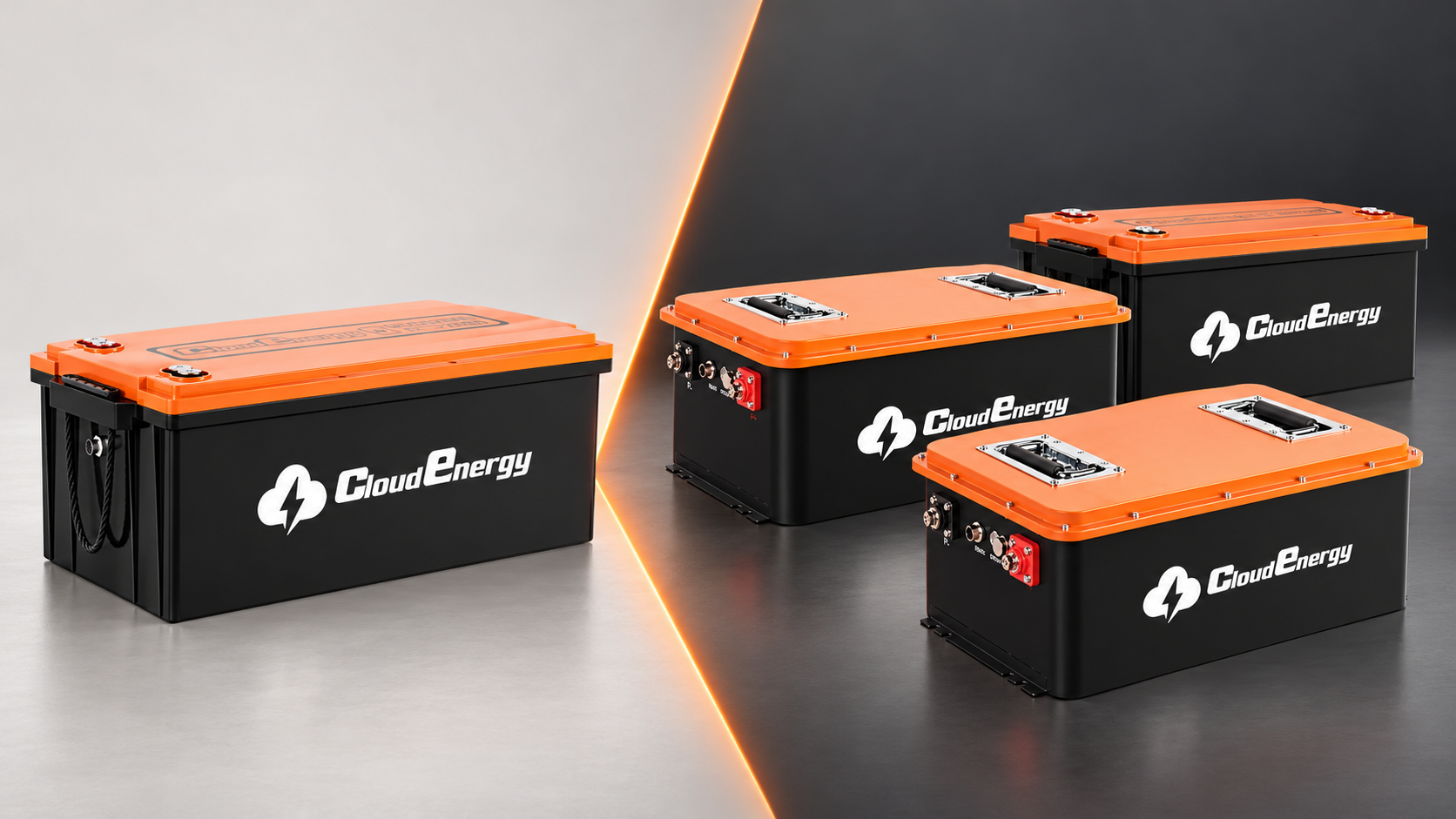
UL 2271 is the safety standard commonly associated with battery packs used in light electric vehicle applications. CloudEnergy now offers four golf cart LiFePO4 battery models certified to the 2023 edition of this standard.
In brief: ANSI/CAN/UL/ULC 2271:2023 covers electrical energy storage assemblies for light electric vehicles within its defined scope. It evaluates construction and response to specified electrical, mechanical and environmental conditions. It does not certify driving range, cycle life, vehicle fit or commercial performance.
What products fall within UL 2271?
The full title of the standard is Batteries for Use In Light Electric Vehicle (LEV) Applications. Its scope covers electrical energy storage assemblies such as battery packs, battery/electrochemical-capacitor combinations and the modules or subassemblies that make up those products for use in light electric-powered vehicles.
Golf cart batteries can fall within that light-EV battery category when the product and application meet the scope. The standard does not cover every device that happens to use a rechargeable battery. It specifically excludes battery assemblies intended for on-road passenger electric vehicles, heavy-duty ride-on industrial trucks and light electric rail applications, which are addressed by other standards.
The 2023 designation is written ANSI/CAN/UL/ULC 2271:2023. For buyers, the edition matters: a quotation, certification record and technical document should all identify the exact standard and model rather than relying on a broad phrase such as “UL battery.”
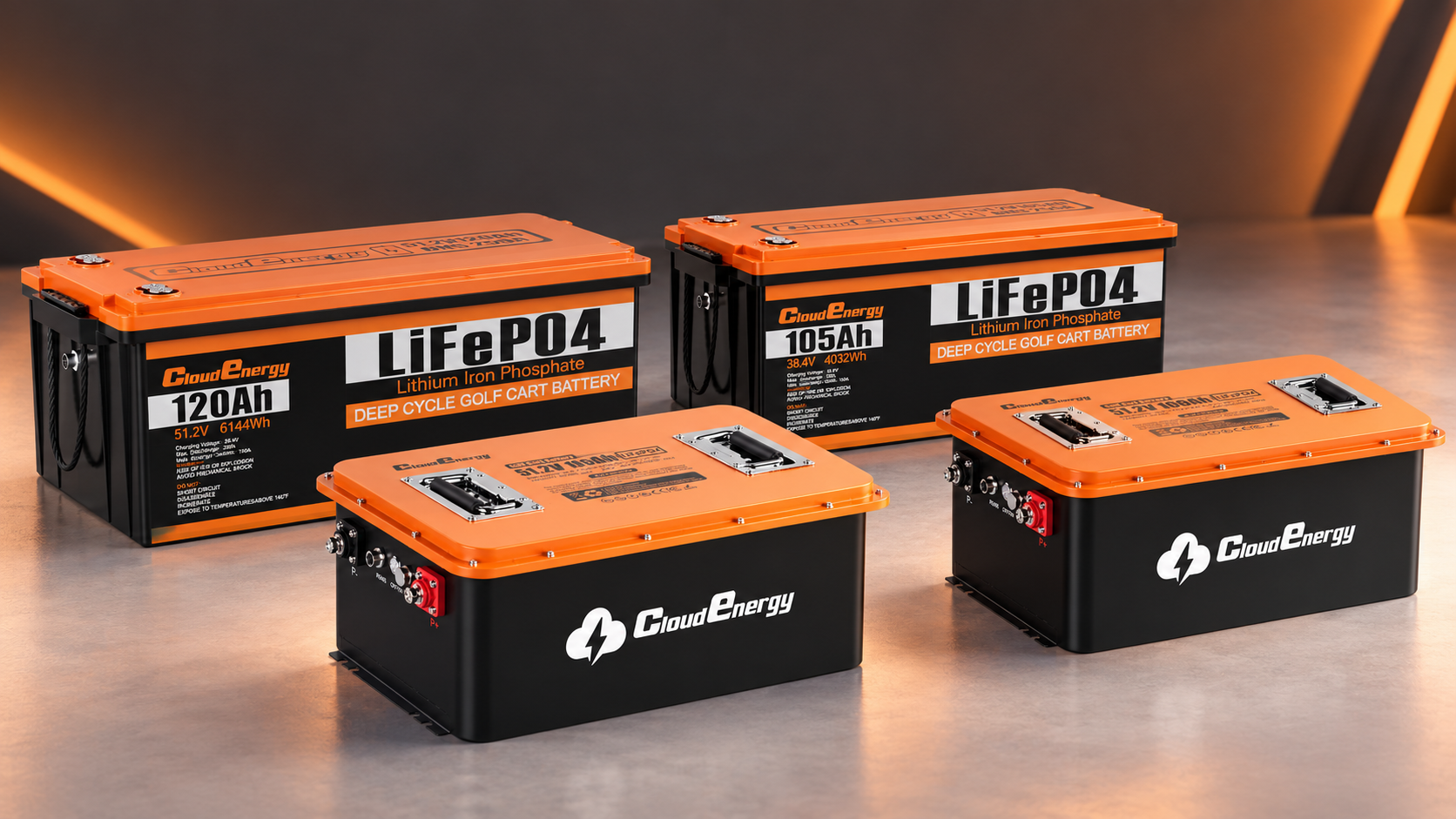
CloudEnergy’s certified golf cart battery lineup includes:
- GFA36V-105Ah With Charger — 38.4Vdc, 105Ah, 4,032Wh
- GFS48V-60AH With Charger — 51.2Vdc, 60Ah, 3,072Wh
- GFS48V-105AH With Charger — 51.2Vdc, 105Ah, 5,376Wh
- GFA48V-120AH-R — 51.2Vdc, 120Ah, 6,144Wh
Certification applies to these specific models. A different prefix, suffix, enclosure, cell configuration or rating should be checked separately.
Which tests are associated with UL 2271 certification?
UL 2271 uses a structured set of construction requirements and tests to examine how a battery assembly responds to foreseeable conditions within the standard. For the four CloudEnergy models, the documented test program included:
- Overcharge and high-rate charging
- External short circuit and overdischarge
- Imbalanced charging and temperature testing
- Vibration endurance, mechanical shock and drop
- Mold stress relief
- Immersion and thermal cycling
- Label permanence
These tests address different parts of the risk picture. Electrical-abuse tests challenge charging, discharging and protective-control behavior. Vibration, shock and drop tests challenge mechanical construction. Temperature and thermal cycling expose the assembly to controlled environmental changes. Label permanence supports the continued visibility of required markings and warnings.
The reports also describe protection circuits for overcharge, overdischarge, overcurrent and short-circuit conditions. Those protections form part of the pack design, but they do not eliminate the need for correct installation, a compatible charger, suitable wiring or adherence to operating limits.
For a deeper look at the individual test categories, see Inside UL 2271 Battery Testing.
What UL 2271 does not tell you
Certification is valuable because it provides a defined, third-party framework. It should not be stretched into claims the standard does not make.
First, UL 2271 does not evaluate device performance or reliability. Certification does not establish how many miles a cart will travel, how quickly it will climb a hill, how many years a battery will last or how its capacity will change over time. Those questions require separate product data and clearly described test conditions.
Second, certification does not mean that every 36V or 48V vehicle is automatically compatible. A battery can match the nominal voltage and still be unsuitable because of controller demand, regenerative current, physical dimensions, terminal layout, charger logic or mounting constraints.
Third, UL certification is not a commercial recommendation or guarantee from UL. It indicates that the identified product has been evaluated under the applicable certification program. The buyer remains responsible for selecting, installing and using the battery correctly.
Finally, product certification is not company-wide certification. The correct statement names the specific certified models. CloudEnergy’s four UL 2271-certified products should not be used to imply that every CloudEnergy battery has the same certification.
How buyers should verify a UL 2271 battery
A useful qualification process compares documents, labels and the quoted product line by line.
Match the model exactly. Do not treat GFA36V-105Ah and GFS48V-105AH as interchangeable simply because both are 105Ah. They use different nominal voltages and cell configurations.
Confirm voltage and charging limits. The 36V-class GFA model uses a 43.8V charge voltage, while the 48V-class models use 58.4V. A charger designed for one voltage class must not be assumed suitable for the other.
Review current demand. Compare the controller’s normal, peak and regenerative-current behavior with the battery’s published limits. Amp-hours describe charge capacity; they do not replace current ratings.
Check the installation environment. Evaluate compartment size, restraint, terminal protection, cable routing, water exposure, temperature and service access. Follow the battery and vehicle instructions.
Keep transport documents separate. UN 38.3 reports support lithium-battery transport planning. They complement, but do not replace, UL 2271 product certification.
Request current records. For a commercial purchase, ask for the certification details and technical documentation for the exact model on the quotation and label.
Turning certification into a better buying decision
The value of UL 2271 certification is greatest when it becomes part of a complete application review. A buyer can use the certification as an initial filter, then compare voltage, energy, current, charge profile, temperature limits and physical integration.
For example, a compatible 48V cart with shorter daily routes may not need the same nominal energy as a vehicle used for long shifts, passenger service or repeated trips. The 3,072Wh GFS48V-60AH, 5,376Wh GFS48V-105AH and 6,144Wh GFA48V-120AH-R provide three different energy tiers within the same nominal voltage class. The right choice depends on measured demand and operating margin, not on choosing the largest number automatically.
Start with the CloudEnergy 36V and 48V battery comparison, then request a model review before ordering.
Contact CloudEnergy with your cart model, voltage, controller, charger, battery-bay dimensions and typical use profile.
FAQ
Is UL 2271 specifically a golf cart battery standard?
UL 2271 covers battery assemblies for light electric vehicle applications within its scope. Golf cart battery packs can be evaluated under the standard, but the scope is broader than golf carts alone.
Is “UL approved” the correct term?
“UL approved” is not a precise certification designation. Use the exact terminology in the applicable certification record. This series describes the identified CloudEnergy models as UL 2271-certified.
Does UL 2271 certification include the charger?
Battery and charger coverage should be checked in the applicable certification documentation. A product name containing “With Charger” does not, by itself, define the charger’s certification scope.
Is a UL 2271 battery automatically legal for every market?
No. Market access can also depend on local regulations, installation codes, vehicle rules, shipping requirements and other product-specific obligations.
What is the difference between UL 2271 and UN 38.3?
UL 2271 is a product-safety standard for light-EV battery assemblies. UN 38.3 is a transport-testing framework for lithium cells and batteries. They serve different purposes.
See the complete comparison in UL 2271 vs. UN 38.3 for Golf Cart Batteries.